
Article—
Simon Lanham Was Stabbed 5 Times, He Miraculously Survived — and Still Treated Like the Offender
Simon Lanham survived being stabbed five times by his former partner, yet like many male victims of domestic violence, he says he was treated as though he had done something wrong. His story exposes how easily male victims can be misidentified as perpetrators.
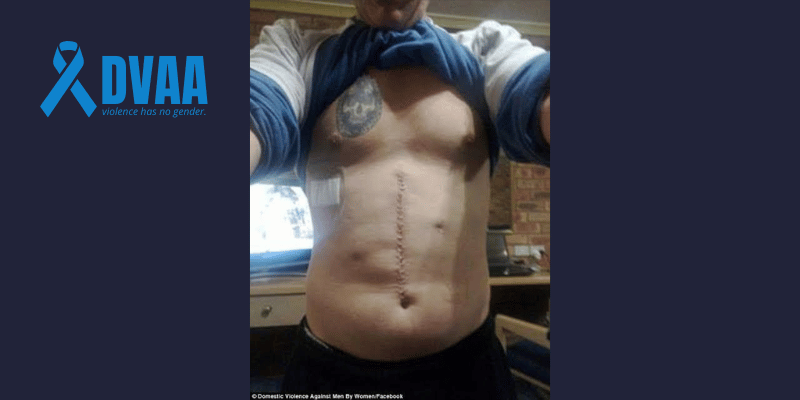
Simon Lanham shows the scar left by emergency surgery after being stabbed by his former partner.
Credit: Domestic Violence Against Men By Women / Facebook
When Simon Lanham spoke publicly about the domestic violence he had experienced, he described something that should have been almost impossible to misunderstand.
This article discusses domestic violence, physical assault and stabbing.
He said his former partner had attacked him with knives on multiple occasions. During the most serious incident, Lanham said he was attacked from behind in the dark and stabbed repeatedly with a kitchen knife. He required emergency surgery and was left with a substantial scar through the centre of his abdomen.
Yet Lanham's story is not only about surviving violence.
It is also about what can happen when a male victim eventually reacts, physically defends himself or strikes back after prolonged violence. Instead of the entire history of abuse being examined, the defensive action may be isolated from everything that came before it. The victim can then find himself treated as the perpetrator.
A History of Violence That Reportedly Escalated
In a 2015 A Current Affair report examining male victims of domestic violence1, Lanham described previous occasions when his former partner had approached him with a knife.
According to Lanham, those earlier attacks occurred when he could see her approaching and was able to stop her. During the near-fatal incident, however, he said it was dark and that she attacked him from behind.
Lanham told the program that he was "on the brink of death" after being stabbed repeatedly. The reporting showed the extensive scar left by the surgery required to save his life.
The story was subsequently covered by the Daily Mail Australia2, the Border Mail3 and other media and advocacy organisations. In 2017, Lanham also appeared in a television documentary with journalist Ray Martin examining domestic violence and the experiences of male victim-survivors.
Lanham has continued to speak publicly about what happened to him. More recent interviews have described him as having been stabbed multiple times but nevertheless authorities treated him as though he had done something wrong.
When a Victim Finally Reacts
One of the most troubling parts of Lanham's account concerns a separate violent incident.
Lanham told the media that his former partner spent approximately 12 hours attempting to provoke him into retaliating. He alleged that during this period he was punched repeatedly, spat on, grabbed by the testicles, pulled to the ground and kicked.
He said that after being cornered, he eventually struck her.
That final action cannot properly be understood without considering the many hours of alleged violence that preceded it. Extracting the moment in which a victim responds and presenting it without context can completely reverse the apparent roles of victim and perpetrator.
This is particularly dangerous for male victims.
A man may be physically larger than his female partner. Police attending an incident may therefore assume that he represents the greater threat. He may have fewer visible injuries, particularly where he has blocked attacks or been assaulted in areas covered by clothing. He may also be ashamed, distressed, angry or unable to explain a long pattern of abuse during a brief and highly charged police interaction.
Meanwhile, the person who initiated the violence may point to the victim's eventual defensive response as evidence that he is the abuser.
Being Physically Stronger Does Not Remove the Right to Survive
Men are frequently told that they should simply walk away, restrain their attacker or absorb the violence without responding.
That expectation is neither realistic nor lawful.
A knife does not become less dangerous because the person holding it is smaller. A punch, kick, blunt object or attack on a vulnerable part of the body does not become harmless because the victim is male.
Under section 418 of the NSW Crimes Act 19004, a person is not criminally responsible for conduct carried out in self-defence where the person believes the conduct is necessary to defend themselves or another person and the conduct is a reasonable response in the circumstances as they perceive them.
Self-defence does not provide an unlimited right to retaliate or punish another person. Each case depends on the circumstances, including the threat faced, what the accused person believed was necessary and whether their response was reasonable.
However, the law clearly recognises that a person under attack is entitled to protect themselves.
The problem arises when a male victim's defensive action is treated as the beginning of the incident rather than the end of a much longer sequence of coercion, intimidation and violence.
Charges Are Not Proof of Guilt
Police may lay charges where there are competing allegations or where both parties have used physical force. A charge does not mean that self-defence is unavailable, nor does it establish that the person charged was the primary aggressor within the relationship.
Nevertheless, being charged can have immediate and devastating consequences.
A person may be removed from their home, subjected to an apprehended violence order, separated from their children, required to obtain legal representation and publicly identified as a domestic violence offender.
Even when charges are later withdrawn or successfully defended, the reputational, financial and emotional damage may already have occurred.
There is no reliable national dataset establishing precisely how often Australian male victim-survivors are charged after using defensive force. We should not invent a statistic where one does not exist.
What is established is that the misidentification of domestic violence victim-survivors as perpetrators is a recognised problem within Australian policing and domestic violence law5. Australian research has called for decision-makers to examine the history of the relationship, patterns of coercive control, systems abuse and the identity of the person most in need of protection rather than relying only on the final incident visible to police.
Much of the existing Australian research into misidentification has understandably focused on women, particularly Aboriginal and Torres Strait Islander women. But the central principle must be applied consistently: every domestic violence incident should be assessed according to the evidence and the complete pattern of behaviour, not assumptions about the sex of the victim or perpetrator.
Male Victims Should Be Equally Recognised
Recognising male victims does not require denying or minimising female victims.
It does require acknowledging that hundreds of thousands of Australian men have also experienced violence from an intimate partner.
The Australian Institute of Health and Welfare6 reports that approximately 693,000 Australian men have experienced physical or sexual violence from an intimate partner since the age of 15. The Australian Bureau of Statistics7 has estimated that 15 per cent of Australian men have experienced violence, emotional abuse or economic abuse from a cohabiting partner.
These men are not statistical errors.
They are fathers, sons, brothers, friends and colleagues. Some have been punched, kicked, stabbed, threatened, controlled, financially abused or isolated from their children. Many do not report what is happening because they fear ridicule, disbelief or being identified as the aggressor.
Lanham's experience demonstrates why that fear cannot simply be dismissed.
The Justice System Must Examine Context, Not Gender
Domestic violence responses should not begin with the assumption that the man is the perpetrator and the woman is the victim.
Nor should they automatically assume the reverse.
Authorities must determine:
- Who initiated the violence?
- Was one person attempting to escape, block or stop an attack?
- Was the visible incident part of a longer pattern of coercive control?
- Were weapons involved?
- Had there been previous threats or assaults?
- Were allegations being used to manipulate police or the courts?
A victim's defensive behaviour may not always appear calm, controlled or perfectly proportionate when examined later from the safety of a courtroom. People experiencing a violent attack act under fear, confusion and intense physical stress.
That does not mean every claim of self-defence should automatically be accepted. It means the claim must be properly investigated rather than dismissed because the person making it is male.
Simon Lanham's Story Deserves to Be Remembered
Simon Lanham survived an attack that could have killed him.
He then spoke publicly about the barriers faced by male victims and the experience of feeling that he was being treated as though he had done something wrong.
His story challenges a simplistic understanding of domestic violence in which perpetrators and victims can always be identified by sex alone.
Domestic violence is defined by behaviour: violence, coercion, intimidation, threats and control.
A man who uses reasonable force because he genuinely needs to stop an assault is not automatically a domestic violence perpetrator. He may be a victim attempting to survive.
Police, courts, journalists and domestic violence organisations must be prepared to recognise that reality.
Every genuine victim deserves safety.
Every allegation deserves a proper investigation.
And no person who has survived a potentially fatal attack should be presumed to be the offender simply because he is a man.
Support Services
Anyone can experience domestic or family violence, regardless of sex, gender, age or background.
If you are in immediate danger, call 000.
- Lifeline: Call 13 11 14 for confidential crisis support, available 24 hours a day.
- 1800RESPECT: Call 1800 737 732 for confidential information, counselling and support.
References
-
A Current Affair — Domestic Violence Dads: the victims of domestic violence we rarely hear from ↩
-
Daily Mail Australia — Domestic violence victim Simon Lanham was stabbed by his girlfriend and says male victims face double standards ↩
-
Border Mail — Albury father who was knifed by former de facto partner speaks to Ray Martin ↩
-
ANROWS — Accurately identifying the "person most in need of protection" in domestic and family violence law ↩
-
Australian Institute of Health and Welfare — Family, domestic and sexual violence: men ↩
-
Australian Bureau of Statistics — Personal Safety, Australia, 2021–22 ↩
Need Legal Help?
Understand your rights and options
DVAA provides connections to legal professionals who are experienced in these matters.
Complete the legal enquiry form →Comments
VITE_FACEBOOK_APP_ID to enable them.