
Article—
Intimate Partner Homicide in Australia Has Fallen Over Time
New AIC homicide data shows intimate partner homicide in Australia has decreased significantly since 1989–90, including falls in both female and male victimisation rates.
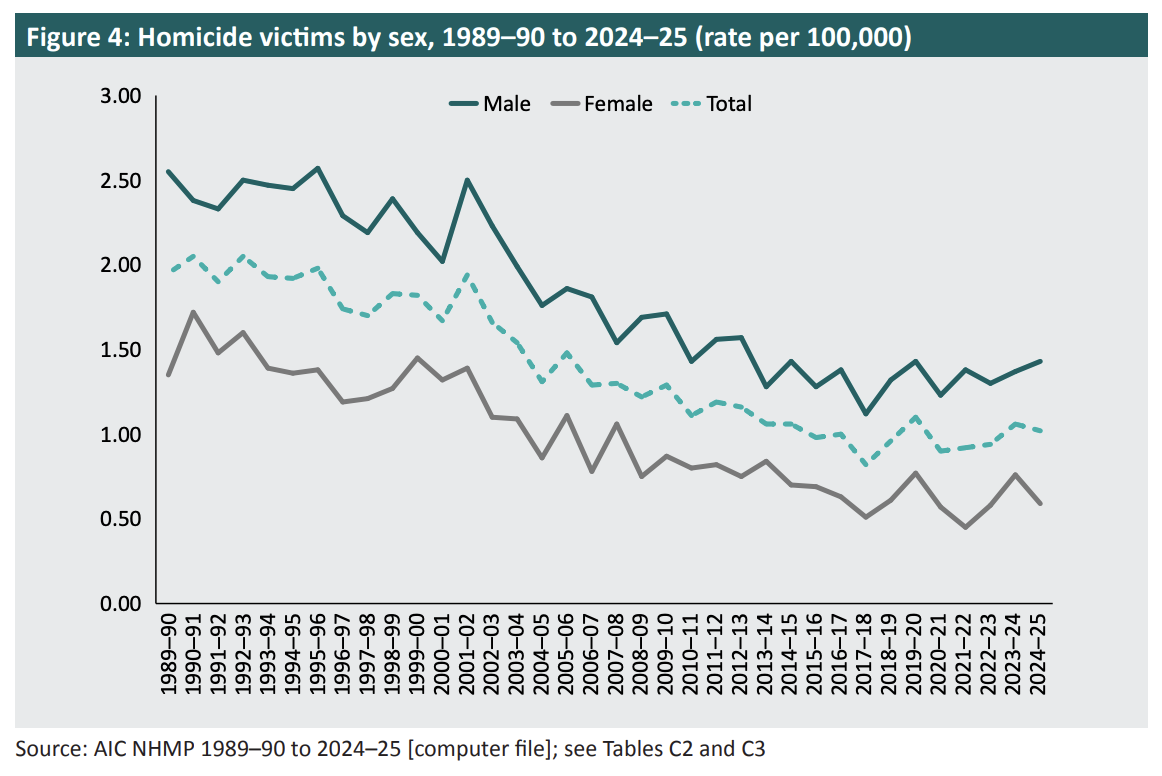
Intimate Partner Homicide in Australia: What the Latest Data Shows
The latest Australian Institute of Criminology report, Homicide in Australia 2024–25, provides an important update on homicide trends across the country.
One of the most important findings is this: the intimate partner homicide rate in Australia has steadily decreased over the long term.
This does not minimise the tragedy of any individual death. Every homicide represents a person, a family, and a community changed forever. But if we are serious about domestic violence policy, public education, prevention and support, we need to look carefully at the evidence — not just the headlines.
The Long-Term Trend Is Downward
According to the Australian Institute of Criminology, there were 46 intimate partner homicide incidents in 2024–25, down from 58 incidents in 2023–24.
Of those 46 incidents:
- 32 involved a female victim
- 14 involved a male victim
This means women still made up the majority of intimate partner homicide victims in 2024–25. However, the broader trend over time shows a substantial decline in intimate partner homicide rates for both women and men.
The AIC reports that the female intimate partner homicide rate has decreased by 70% since 1989–90.
The male intimate partner homicide rate has also decreased by 63% since 1989–90.
That is a significant long-term shift.
Why This Matters
Public discussion around domestic violence is often emotionally charged, and understandably so. The subject involves grief, trauma, fear and deep community concern.
But good policy needs clear thinking.
If intimate partner homicide has decreased significantly over time, then the public conversation should reflect that. We should be asking:
- What has helped reduce these deaths?
- Which interventions are working?
- Where are the remaining risks?
- Who is still falling through the cracks?
- How do we support all genuine victims of domestic and family violence?
The goal should not be to win an argument. The goal should be to reduce harm.
The Data Still Shows Serious Risk
While the long-term decline is encouraging, the 2024–25 figures still show that intimate partner homicide remains a serious issue in Australia.
The AIC report found that intimate partner homicide made up 17% of all homicide incidents in 2024–25 and 51% of domestic homicide incidents.
This means intimate partner homicide is still a major part of Australia's domestic homicide landscape.
The data also shows that intimate partner homicide affects both women and men, although not in the same numbers. In 2024–25, around seven in ten intimate partner homicide victims were female, while three in ten were male.
A serious national conversation should be able to acknowledge both facts at the same time.
Men are also victims of intimate partner homicide.
The obvious difference is that men are physically stronger and less likely to be killed by their female partner. Therefore, we have a survivorship bias presenting in the data.
Watch: Discussion on Domestic Violence and Homicide Data
Damian Coory from The Other Side summarises the situation very well in this video.
A Better Conversation About Domestic Violence
At DVAA, we believe Australia needs a more balanced, evidence-based and humane conversation about domestic and family violence.
That means recognising female victims.
It also means recognising male victims.
It means taking children, families and intergenerational trauma seriously.
It means supporting victims without turning complex human problems into slogans.
It also means being honest when the data shows improvement. If intimate partner homicide has declined over decades, that is worth acknowledging. Not because the problem is solved — it clearly is not — but because understanding progress helps us understand what may be working.
Progress Should Not Lead to Complacency
A falling homicide rate does not mean domestic violence has disappeared.
It simply means that when we look at intimate partner homicide specifically, the long-term trend is downward.
That should give policymakers, service providers and community advocates a reason to look more carefully at the full picture.
The next step is not denial.
The next step is better evidence, better services, and better outcomes for everyone affected by domestic and family violence.
Final Thought
Every death is one too many.
But every public conversation about domestic violence should be grounded in truth.
The latest AIC data shows that intimate partner homicide in Australia has significantly decreased over time. That is an important fact — and it should help shape a more honest, compassionate and effective national response.
Need Legal Help?
Understand your rights and options
DVAA provides connections to legal professionals who are experienced in these matters.
Complete the legal enquiry form →Comments
VITE_FACEBOOK_APP_ID to enable them.