
Article—
Pauline Hanson Says "Domestic Violence Is a Two-Way Street": Please Explain?
Dr Fiona Girkin examines the evidence behind Pauline Hanson's claim that domestic violence is a two-way street, including PASK findings on bidirectional intimate partner violence.
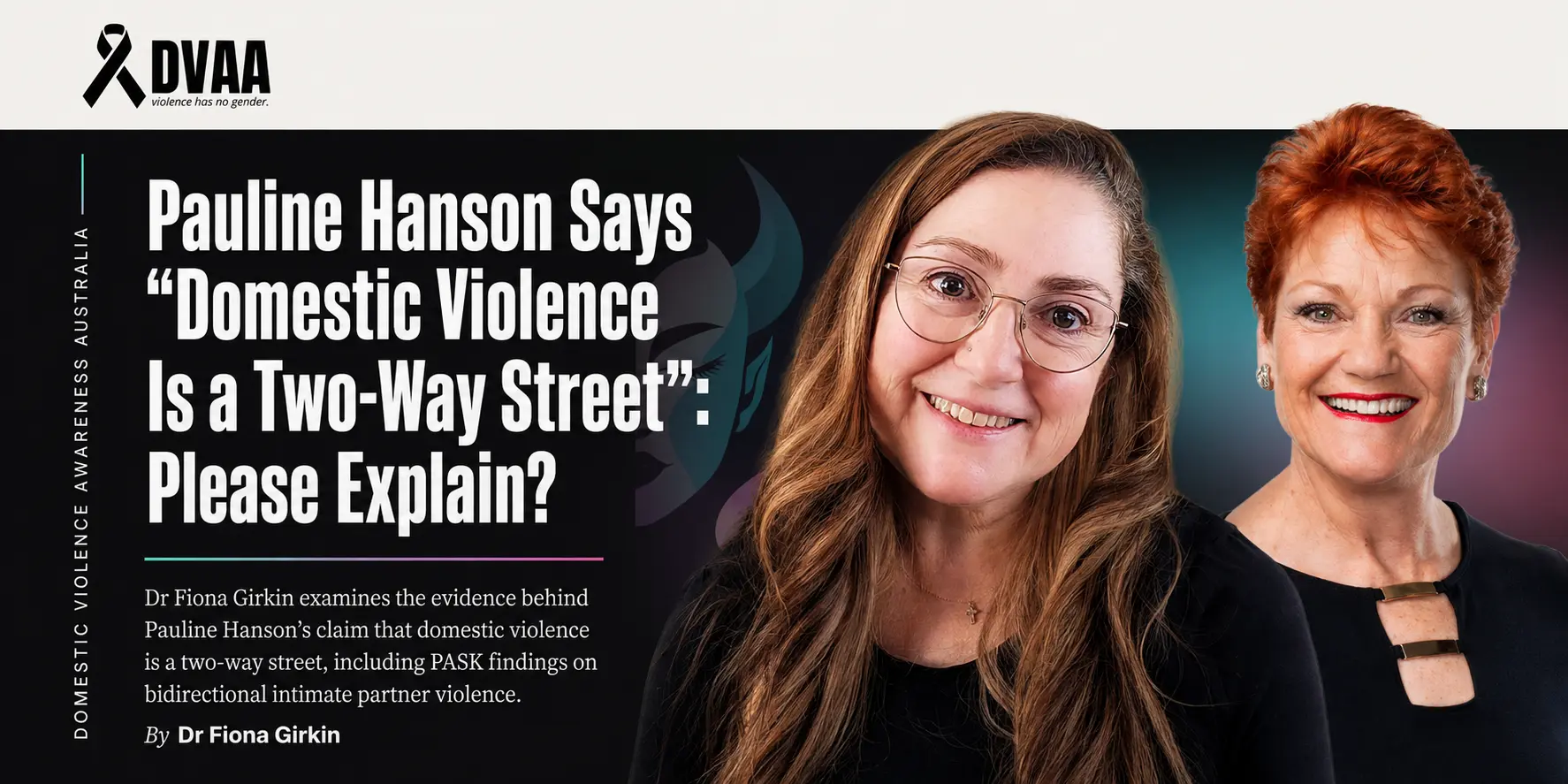
Senator Pauline Hanson's "two-way street" comment reignited debate over bidirectional intimate partner violence in Australia.
Credit: One Nation / DVAA
Senator Pauline Hanson recently described Intimate Partner Violence (IPV) as "a two-way street" 1. Politicians, advocacy organisations and commentators accused her of minimising violence against women and misrepresenting domestic violence. Within days, the public debate had become deeply polarised, with many people compelled to either defend or condemn Hanson.
Amid the political commentary and media headlines, a more important question received little attention: What does the evidence actually say, and was she right?
Going against the grain
The controversy surrounding Senator Hanson's remarks is not without precedent.
In May 2025, I was involved in a similar public debate following an interview with men's rights advocate Bettina Arndt on IPV. Although the context differed, the pattern was eerily familiar. Instead of focusing on the evidence related to the issue, specifically, that men and women commit violence at similar rates, much of the public discourse centred on whether my views were acceptable to express. This was especially pertinent because I was also educating Police on IPV dynamics. The questions about female perpetration, male victimisation, and bidirectional violence quickly became overshadowed by the controversy over my claims and not whether or not they were true.
This article is not about defending Senator Hanson, nor is it about revisiting my own experience of publicly speaking against the common narrative. It is about something far more important: whether public policy on IPV is being informed by all the evidence and not just what is politically favourable.
Public policy should be based on genuine evidence that considers the motivations and biases behind claims. Research often begins with bias, as many researchers and services operate within a feminist framework that views women as victims and men as perpetrators. Historically, the feminist movement has portrayed IPV as "men abusing women" to obtain funding, services, and professional benefits 2. Multiple credible studies provide strong evidence of substantial underreporting of male victimisation and female perpetration 2 3 4 5 6. These scholars promote a gender-neutral approach, arguing that the feminist perspective distorts public understanding and influences laws in ways that hide women's violence and stigmatise male victims.
So yes, Senator Hanson makes a very good point, even if the statement is simplified, because relationships are more than one person, and how we interact and communicate can be influenced by the other person. Therefore, rather than asking whether the statement made by Senator Hanson is right or wrong, this article instead considers the following:
What does the evidence say about Senator Hanson's statements, and what insights can this debate offer into the discussion of IPV in Australia?
Let's look at the underreported evidence behind the Senator's claims.
"Domestic violence is a two-way street."
A common finding in community-based IPV studies is that violence is frequently bidirectional, with both partners engaging in violence, a fact rarely highlighted by mainstream media.
The recently published Partner Abuse State of Knowledge Project 2025–2026 (PASK) 7 reported that 53% of IPV was bidirectional, with female-perpetrated violence surpassing male-perpetrated violence. These findings have remained relatively consistent since the 2012 PASKs. When looking at perpetration by gender, about 17.5% of women and 10.6% of men commit violence, meaning 1 in 6 women and 1 in 9 men are involved in perpetration. This is not a new insight; the notion that domestic violence is often "a two-way street" has been understood for some time, although it rarely makes headlines at the local or national level.
Professor Murray Straus 4 5 6 was among the most influential scholars exploring a non-gendered perspective on IPV, arguing that women commit violence at rates comparable to men. In 2011, he analysed 200 studies on domestic violence, concluding that both women and men are equally likely to engage in such violence. Some argue this is because women have to defend themselves; however, his research showed that less than 15% of female violence is self-defence. In a separate study, Straus 4 identified bidirectional violence as the most prevalent form, followed by female-only and male-only IPV. He noted that severe violence is uncommon, is perpetrated mainly by males, and that women often suffer more serious injuries and even death 5.
Understandably, the picture becomes more complicated when IPV is defined narrowly, focusing only on serious physical assault. These forms of abuse are more commonly perpetrated by men and are associated with greater physical injury and a higher risk of homicide, which is why the public conversation is skewed towards the politically convenient and easy-to-digest assessment that men are always villains and women are always victims.
The issue isn't what Senator Hanson said but the ongoing feminist and outdated view of IPV as a gender-specific problem. Framing IPV as a single-issue problem leads to research, policies, and interventions that lack nuance and don't fully account for the range of behaviours between partners. This prevents proponents of the current approach from recognising the motivations, intentions, and actions that can lead to IPV. A more comprehensive understanding could better explain how to reduce relationship violence, which cannot be achieved by simply investing in feminist services that maintain the same narrative.
Women can be perpetrators
The concept of domestic violence is closely tied to the idea that it is always committed by men. This belief is so ingrained in public discussion that even when women behave violently towards men, it is often seen as the man's fault. Consequently, any proposal that violence might be mutual usually triggers widespread outrage, regardless of the available evidence.
The evidence that women can perpetrate IPV is substantial.
Numerous studies report female perpetration of physical aggression, with some finding comparable perpetration rates between men and women 6 8, while others report that women commit domestic violence at higher rates than men 9 10. In cases of nonreciprocal violence, women accounted for over 70% of violence, and in 80% of cases where a man attended a behaviour change program, his female partner was the one who reinitiated violence 6. This highlights that in some cases involving women in behaviour change programs alongside their male partners could be vital, as most male violence rarely occurs in isolation.
Research consistently indicates that men do experience IPV, but they are much less likely to report abuse or seek assistance. Studies cite several reasons for this, such as stigma, embarrassment, fears of not being believed, and a scarcity of services tailored for male victims. Recognising male victims does not lessen the experiences of female victims; it instead expands the scope of domestic violence support, ensuring help is available for all victims.
Beyond politics
One of the difficulties in Australia's domestic violence debate is that evidence is often interpreted through a single theoretical framework, seeing IPV as a gendered issue embedded in patriarchal views. It should not be considered an offence against humanity to open the door to alternative explanations of why IPV occurs. If objective truth offends certain groups but brings real solutions to people experiencing violence in relationships, I am happy to risk offending those groups in order to alleviate the suffering of many men and women across our nation.
Whether one agrees with Senator Hanson politically is ultimately beside the point. Public policy should not be determined by the popularity or unpopularity of the person making a claim. Instead, each claim should be evaluated on its own merits against the available evidence. In this case, the evidence suggests Senator Hanson was correct, and that much of the public debate failed to distinguish between these differences. Good policy requires more than slogans. It requires evidence.
Conclusion
Domestic violence is one of Australia's most significant social issues. It deserves careful analysis rather than ideological or political vote-winning debate. By spending time arguing how offensive Senator Hanson's statements are, mainstream commentators dogmatically assume that the reported statistics are one hundred per cent accurate. Moreover, the emotionally charged language often accompanying the responses indicates a preference for talking about how her statements make us feel, rather than whether there might be a kernel of truth in them. This means Senator Hanson's statements are broadly consistent with much of the research on IPV, but it oversimplifies the issue; instead of saying IPV is a "two-way street", it may be better to say: Intimate relationships are complex, and gender alone cannot fully explain the inception of IPV.
References
References
-
4BC Brisbane radio interview with Gary Hardgrave (22 July 2026). "GIVE ME THE JOB!": Pauline Hanson drops bombshell declaration on becoming Prime Minister. ↩
-
Abrams, J. (2016). The feminist case for acknowledging women's acts of violence. Yale Journal of Law & Feminism, 27, 287. ↩ ↩2
-
Buttell, F., & Starr, E. (2012). Lifting the veil: Foundations for a gender-inclusive paradigm of intimate partner violence. In Perceptions of Female Offenders (pp. 117–132). Springer. ↩
-
Straus, M. A. (2008). Dominance and symmetry in partner violence by male and female university students in 32 nations. Children and Youth Services Review, 30(3), 252–275. ↩ ↩2 ↩3
-
Straus, M. A. (2011). Gender symmetry and mutuality in perpetration of clinical-level partner violence. Aggression and Violent Behavior, 16(4), 279–288. ↩ ↩2 ↩3
-
Straus, M. A. (2014). Addressing violence by female partners is vital to prevent or stop violence against women: Evidence from the Multisite Batterer Intervention Evaluation. Violence Against Women, 20(7), 889–899. ↩ ↩2 ↩3 ↩4
-
Langhinrichsen-Rohling, J., & Schroeder, G. E. (2026). Partner Abuse State of Knowledge (PASK) Project 2025–2026 Update: A Decade's Advancement Considered Across Seven Key Articles. Partner Abuse. ↩
-
Whitaker, D. J., Haileyesus, T., Swahn, M., & Saltzman, L. S. (2007). Differences in frequency of violence and reported injury between relationships with reciprocal and nonreciprocal intimate partner violence. American Journal of Public Health, 97(5), 941–947. ↩
-
Bates, E. A., Graham-Kevan, N., & Archer, J. (2014). Testing predictions from the male control theory of men's partner violence. Aggressive Behavior, 40(1), 42–55. ↩
-
Ehrensaft, M. K., Moffitt, T. E., & Caspi, A. (2004). Clinically abusive relationships in an unselected birth cohort: Men's and women's participation and developmental antecedents. Journal of Abnormal Psychology, 113(2), 258–270. ↩
About the Author
Dr Fiona Girkin
Consultant, Researcher and Advocate
Dr Fiona Girkin is an Australian consultant, researcher and advocate whose work focuses on toxic female behaviour, personality disorders, male victims of abuse, and evidence-based approaches to domestic and family violence. After a career spanning sexual assault services, family dispute resolution, policing education and domestic violence training, she now works independently to produce research, educational content and consulting focused on issues she believes have been overlooked within mainstream discussions. Her work contributes to an important conversation about ensuring domestic violence policy remains grounded in research, fairness and equal protection for everyone.
Need Legal Help?
Understand your rights and options
DVAA provides connections to legal professionals who are experienced in these matters.
Complete the legal enquiry form →Comments
VITE_FACEBOOK_APP_ID to enable them.